
You need an active membership to access this lesson.
I. ATTACK STANCE
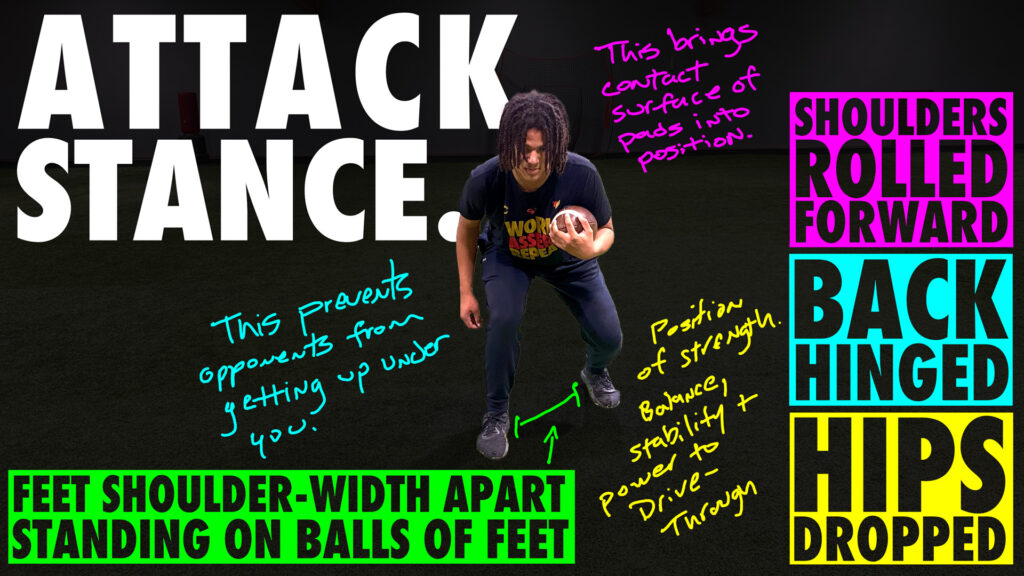
Attack Stance is an offensive or defensive stance used to properly prepare the body for contact. Used correctly, athletes can reduce the risk of injury, as well as, generate more power to tackle and break tackles more effectively and efficiently.
II. ON OFFENSE
On offense, Attack Stance:
- Lowers and places your shoulder pads into the proper position to absorb + reduce the force of contact.
- Allows you to better maintain stability on contact.
- Allows you to better absorb and shift off of contact.
- Puts you in a position of power, in order to, better drive through contact.
- Prevents unnecessary contact to the chest, stomach, ribs, forearms, and hands.
- Puts you in a stronger, more powerful, and supportive stance, thus reducing the risk of injury when initiating or receiving contact.
III. ON DEFENSE.
On defense, Attack Stance:
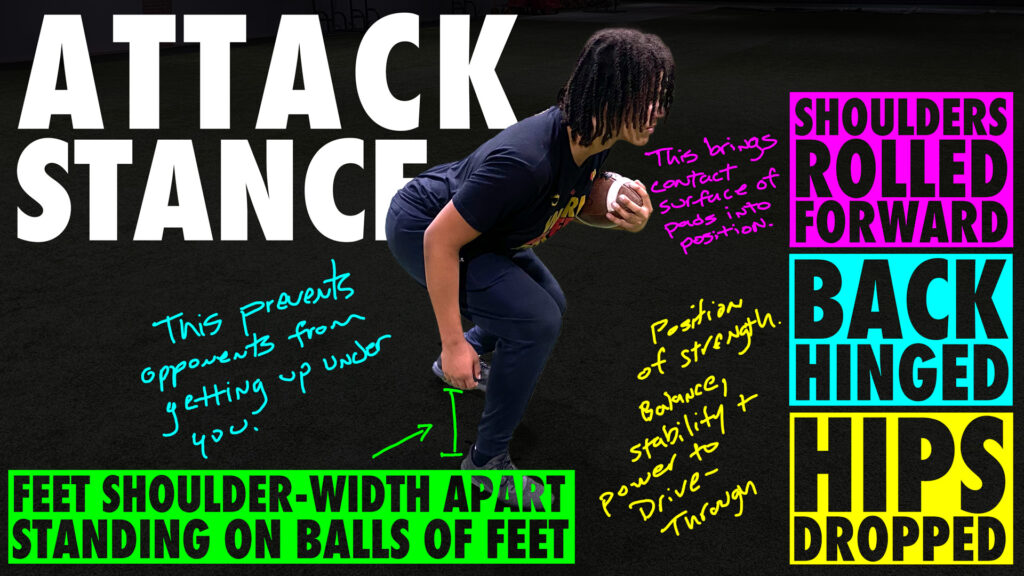
- Lowers and places your shoulder pads in the proper position to absorb + reduce the force of contact, when tackling.
- Puts your body in the proper position to explode up, into, and through tackles, more powerfully, as well as, on the correct angle.
- Puts you in a stronger, more powerful, and supportive stance, thus reducing the risk of injury when initiating or receiving contact.
IV. THE SCIENCE
Attack Stance is all about power and stability. This concept is based on the fact that, when it comes to the kinetic chain, straight lines (standing straight up), create significantly less power and stability than angles. Consequently, when the body is in an upright position it’s much easier to push, pull, or move from side to side. However, in Attack Stance, the kinetic chain creates angles and is therefore capable of creating significantly more power, as well as, providing the required support to make pushing, pulling, or moving it from side to side, harder.
For example, stand straight up with your feet together. Then, have someone push you, pull you, and knock you from side to side. Next, assume Attack Stance, then have them push, pull, and knock you from side to side, again. Which stance was it easier for them to knock you off balance and move you?
Another example. Try jumping without bending your knees. Then, try jumping again, this time bending your knees. Were you able to create more power to jump higher by bending or not bending your knees?
V. A SAFER STANCE IS A BETTER STANCE
Attack Stance also provides superior protection from non-contact, as well as, contact injuries. And, again, this has everything to do with angles.
By dropping the hips, your knees bend and thus remove any straight lines from the legs. By removing these straight lines, the entire leg is now capable of rotating (inward/outward) at the hip. So, if contact were to occur to the side of the knee (in conjunction with proper footwork), this rotation would provide an increased range of motion that would significantly reduce the amount of force to the knee on contact. However, if the leg were straight, it would suffer a decreased range of motion at the hip, and on contact, be much more susceptible to MCL and ACL injuries.
By hinging the back (around 45°) in conjunction with dropping the hips, not only do we properly position the shoulder pads to absorb + reduce the force of contact the way they’re designed to but, it creates a spinal alignment that helps reduce compression of the spine and neck on contact. This reduction in compression is possible because:
- The muscular system is better able to support the head and spine in this position.
- The dropping of the hips and bending of the knees, creates a shock absorber of sorts, that on contact, allows the legs and hips to function like spring.
By keeping the feet shoulder-width apart, we provide ourselves with a wider base. With a wider base, it becomes increasingly more difficult to knock us down or otherwise off balance. Add in proper footwork, and we can prevent our ankles from ever having to support the off-balance load of the body, thus significantly reducing the potential for rollovers and other nagging ankle or foot injuries